If you are asking what is VPS hosting, the short answer is this: it is a private virtual server that lives on a larger physical machine, with its own guaranteed memory, processor share, storage and operating system. You get the control of a server of your own without paying for an entire machine. This guide explains how it works, how it compares with shared hosting and dedicated servers, what it costs in India, and how to pick a size.
What does VPS stand for, and how does it work?
VPS stands for virtual private server. A hosting company takes one powerful physical server and uses software called a hypervisor to split it into several isolated virtual machines. Each one behaves like a separate computer.
A common hypervisor on Linux hosts is KVM (Kernel-based Virtual Machine). With KVM, each VPS runs its own kernel and operating system. One customer can run Ubuntu, the next AlmaLinux, the next Windows Server, all on the same hardware, and none of them can see into the others.
What you get on a typical VPS:
- A fixed amount of RAM that belongs to your server.
- Virtual CPU cores (vCPU), which are a share of the host's processor time.
- Disk space, ideally on NVMe SSD storage.
- A dedicated IP address.
- Root access on Linux, or administrator access over Remote Desktop on Windows.
Root access is the important part. You can install any software, change any setting, open or close ports and run background services. On shared hosting you cannot do most of that.
How is a VPS different from shared hosting?
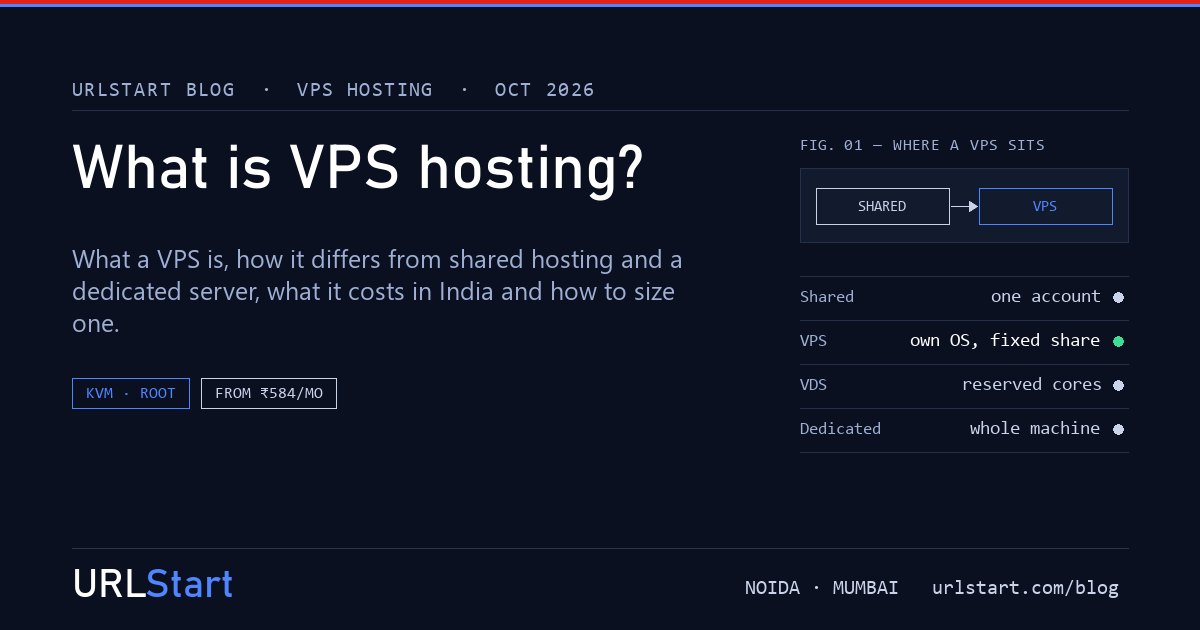
On shared hosting, many websites sit on one server and share one operating system, one web server and one pool of memory. The host manages everything and you get a control panel with a folder for your files.
That is cheap and simple, but it has limits:
- If another site on the server gets busy, yours can slow down.
- You cannot install your own software or change server settings.
- Long-running processes, such as a Node.js app, a trading terminal or a game server, are usually not allowed.
A VPS removes those limits. Your RAM and disk are yours, your operating system is yours, and what other customers do has far less effect on you.
A note on URLStart: we do not currently sell shared hosting to new customers. For anyone outgrowing a shared plan elsewhere, the small Cloud VPS sizes are the step we recommend.
How is a VPS different from a dedicated server?
A dedicated server is a whole physical machine rented to one customer. Every core, every gigabyte of RAM and every disk is yours alone.
A VPS shares the physical machine with other virtual servers, even though your slice is isolated. That has two consequences:
- Cost. A VPS costs a fraction of a dedicated server because the hardware cost is split.
- Ceiling. A VPS tops out at whatever the largest plan offers. A dedicated server gives you far more cores and memory, and steady performance under heavy, constant load.
Most businesses start on a VPS and move to a dedicated server only when they run out of room or need full-machine performance. Our post on the signs you need dedicated cores covers how to tell.
Shared hosting vs VPS vs dedicated server: how do they compare?
| | Shared hosting | VPS | Dedicated server | |---|---|---|---| | What you get | Space on a crowded server | An isolated virtual server | A whole physical machine | | Resources | Shared with every other site | Fixed RAM, vCPU and disk for you | All of the hardware | | Access | Control panel only | Full root or administrator | Full root or administrator | | Install your own software | Rarely | Yes | Yes | | Operating system choice | None | Linux or Windows | Linux or Windows | | Upgrading | Change plan | Resize to a larger plan | Hardware change or migration | | Who manages the server | The host | You, unless you buy management | You, unless you buy management | | Typical use | Small brochure sites | Growing sites, apps, Windows desktops, game servers | Large databases, heavy traffic, many VMs |
Who actually needs a VPS?
You probably need a VPS if any of these is true:
- Your site has outgrown shared hosting. Pages slow down at busy times, or the host keeps warning you about resource limits.
- You run an application, not just a website. Node.js, Python, Laravel, Docker containers or a database that needs its own settings.
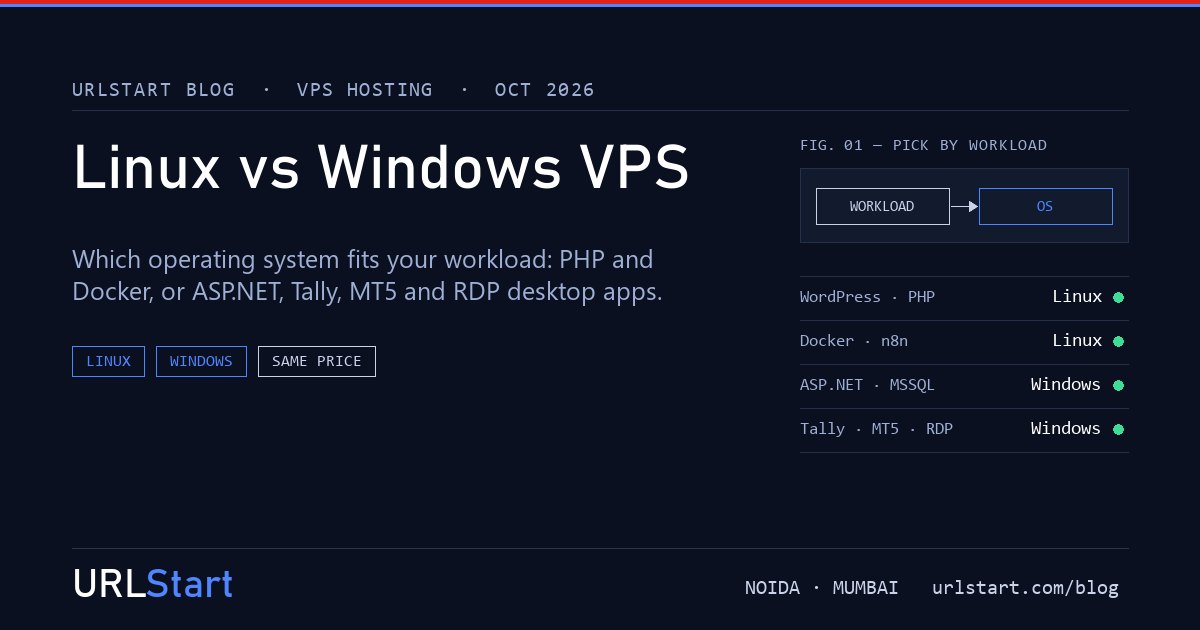
- You need Windows. Running Tally, a trading terminal such as MetaTrader, or desktop software that a team reaches over Remote Desktop.
- You need something running all the time. A forex expert advisor, an automation tool such as n8n, a bot, or a game server for friends or a community.
- You host several sites and want them on one server you control, often with a panel such as cPanel or Plesk.
- You care where your data lives. An Indian business may want its server and data in India.
You probably do not need a VPS if you have one small site with little traffic and no interest in managing a server. A website builder or a basic hosting plan may be enough.
Managed or unmanaged: who looks after the server?
With an unmanaged VPS, the host keeps the hardware, network and virtualisation running. Everything inside your server is your job: updates, security, backups and software.
With a managed VPS, the host or a partner also handles some of that work. The exact scope varies by provider, so read what is included.
If you are comfortable with a command line, unmanaged is cheaper and gives you full freedom. If you are not, budget for management or a control panel. Our guide to managed vs unmanaged servers goes through who does what.
How much does VPS hosting cost in India?
Prices vary with RAM, vCPU, storage type, location, support and whether a Windows licence is included. Watch three things when you compare:
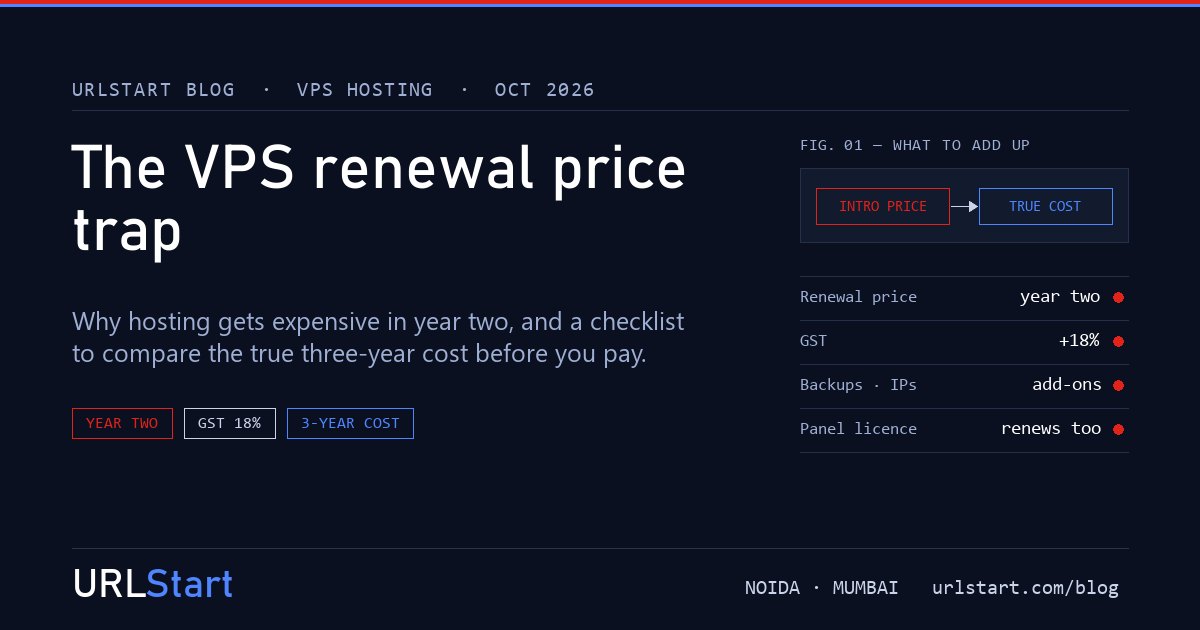
- The renewal price, not just the first-term offer.
- What the CPU share really is, since vCPU counts are not always comparable between providers.
- Extras such as backups, control panel licences and additional IP addresses.
For reference, here are three URLStart Cloud VPS sizes from the live plan table. All run on KVM with NVMe SSD storage and 20 TB of monthly bandwidth:
| Plan | RAM | vCPU | Storage | Monthly price | |---|---|---|---|---| | VPS-4 | 4 GB | 2 | 50 GB | ₹749 | | VPS-8 | 8 GB | 4 | 100 GB | ₹1,299 | | VPS-16 | 16 GB | 6 | 200 GB | ₹2,299 |
There are nine sizes in total, from 4 GB to 64 GB of RAM. Longer billing terms are cheaper: 5% off on three months, 12% off on six and 22% off on twelve, which brings the smallest plan to about ₹584 a month. Windows VPS uses the same sizes with the licence included. Backups are an add-on. For a wider view of the market, see our guide to the best VPS hosting in India.
How do you pick the right VPS size?
The safest method is to measure, then add headroom.
- Check what you use now. On your current host, look at peak memory and CPU use over a normal busy week.
- Add the operating system. A lean Linux server needs a few hundred megabytes for itself. Windows Server needs more, so plan for at least 4 GB.
- Add your software's needs. A database likes RAM for caching. A game server's needs depend on players and mods.
- Start one step above. Leave 25 to 30% free at peak, so a traffic spike does not push the server into swap.
- Upgrade when the numbers say so. Resizing a VPS is quick, so you do not need to buy for next year's traffic today.
Rough starting points:
- One WordPress or small business site: 4 GB RAM, 2 vCPU.
- Several sites, or a store with steady traffic: 8 GB RAM, 4 vCPU.
- Windows with Tally or a few Remote Desktop users: 8 GB RAM upwards, more as users grow.
- A busy app with its own database: 16 GB RAM or more.
Our free plan sizer asks a few questions and suggests a size.
Does the datacenter matter?
Yes, more than many people expect. The datacenter decides how often power or cooling problems can take your server down, and where your data physically sits.
URLStart servers run in a Tier IV datacenter in Noida, Delhi NCR. The facility is Yotta D1, operated by Yotta, which runs the building, power, cooling and physical security. URLStart owns and operates the servers, storage, network and DDoS edge inside its cage. For what Tier IV means in practice, read what a Tier IV data center is.
FAQ
What is VPS hosting in simple words?
It is a private virtual server carved out of a bigger physical server. You get your own RAM, CPU share, disk and operating system, plus full control, at a lower price than renting a whole machine.
Is a VPS better than shared hosting?
For anything beyond a small, quiet site, usually yes. A VPS gives you fixed resources, full root or administrator access and freedom to install software. The trade-off is that you, or someone you pay, must look after the server.
Is a VPS the same as cloud hosting?
Not exactly. A VPS is one virtual server with fixed resources. "Cloud hosting" is a broader term that can mean anything from a single VPS to resources spread across many machines. Many providers, including URLStart, call their VPS product "Cloud VPS".
Can I run Windows on a VPS?
Yes. A KVM VPS can run Windows Server, and you connect over Remote Desktop with administrator rights. URLStart Windows VPS includes the licence, or you can bring your own.
How much RAM do I need on a VPS?
For one WordPress site, 4 GB is a comfortable start. For several sites or a store, 8 GB. For Windows with several users, or an app with a large database, 16 GB or more. Measure your real use and leave about a quarter free at peak.
Can I upgrade a VPS later?
Yes. Moving to a larger size is one of the main advantages of a VPS. It usually needs a short restart, and your data stays in place.
Do I need technical skills to use a VPS?
For an unmanaged Linux VPS, basic command line skills help a lot. If you do not have them, a control panel such as cPanel or Plesk, or a managed service, makes it far easier. Our guide to the first thirty minutes on an Ubuntu VPS is a good place to start.
When should I move from a VPS to a dedicated server?
When your largest sensible VPS size is regularly near its limits, or when you need consistent full-machine performance for heavy databases or many virtual machines. URLStart dedicated servers start at ₹9,999 a month for a dual Xeon E5-2680 v4 build with 64 GB of RAM.