"Tier IV" appears on a lot of hosting websites, including ours. It is worth knowing what it actually promises, because it is a specific engineering standard rather than a marketing grade. It also promises less than people sometimes assume.
What data center tiers measure
The tier system, created by the Uptime Institute, rates the parts of a data center that every server depends on: power and cooling. Power covers utility feeds, UPS batteries and generators. Cooling covers chillers, air handlers and the pipes and ducts between them.
The question each tier answers is simple. If one of those parts fails, or has to be switched off for maintenance, do the servers stay up?
Two terms come up constantly:
- N+1 means one spare component beyond what the load needs. Five UPS units are needed and six are installed, so any one can fail.
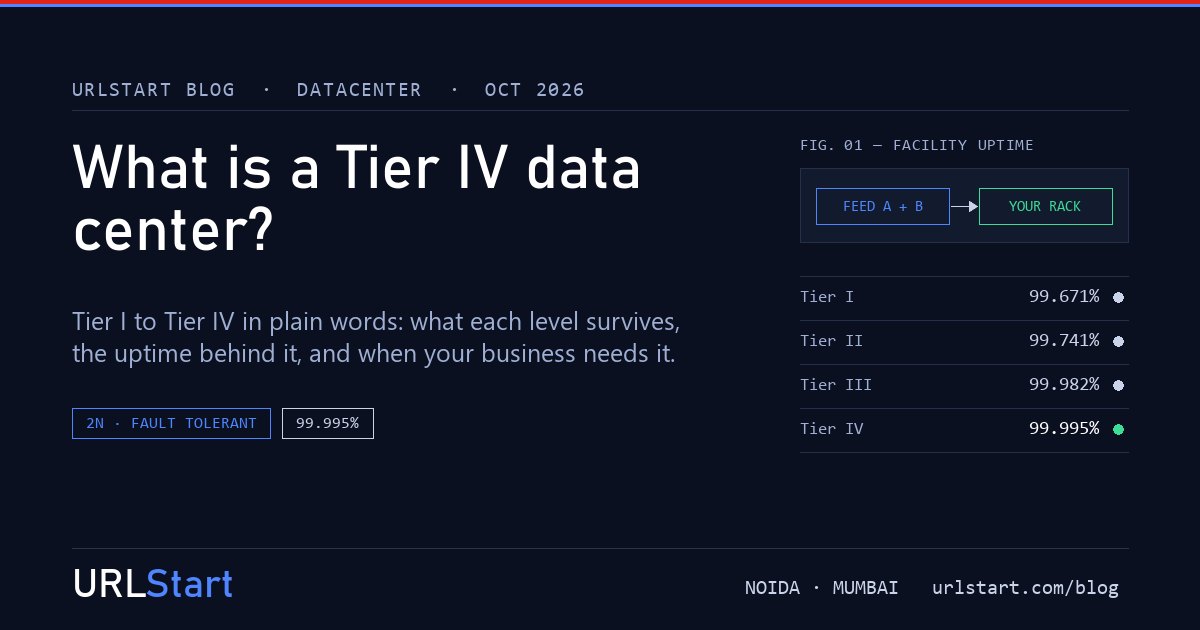
- 2N means a complete second copy of the system: two independent power paths, each able to carry the whole load on its own.
Tier I to Tier IV, in plain words
Tier I: basic capacity
One path for power and cooling, and no spare components. Any failure, and any planned maintenance, takes the servers down. The figure usually quoted is 99.671% availability, roughly 28.8 hours of facility downtime a year.
Tier II: redundant components
Spare components (N+1), but still a single distribution path. A failed UPS unit can be covered, but work on the path itself means an outage. Quoted at 99.741%, about 22 hours a year.
Tier III: concurrently maintainable
Multiple power and cooling paths, with one active at a time, plus N+1 components. Any single part can be taken out for planned maintenance without switching off the servers. An unplanned failure on the active path can still cause an outage. Quoted at 99.982%, about 1.6 hours a year.
Tier IV: fault tolerant
Multiple active paths with full 2N redundancy. Any single failure of a power or cooling component or path, planned or not, is absorbed without the servers noticing. Quoted at 99.995%, about 26 minutes a year.
The difference between Tier III and Tier IV comes down to one word: unplanned. Tier III lets the engineers work on anything without an outage. Tier IV also survives the failure nobody planned for.
What a Tier IV data center does not do
This is where expectations go wrong. A Tier IV rating covers the building: its power, cooling and the paths that feed every rack. It says nothing about:
- your server. A single server with one power supply, one disk or one network card still fails when that part fails. Dual power supplies, RAID and redundant network links are your choice, or your provider's.
- your provider's network. The tier covers the facility, not the routers, switches and upstream transit that carry traffic in and out.
- your software. A bad deploy, a full disk or a security breach takes a site down in any building.
So the honest way to think about Tier IV is that it removes the building as a reason for downtime. That matters a great deal, because power is the most common cause of a whole data center going dark. Everything above the building is still your design.
Do you need a Tier IV data center?
Not every workload does. A rough guide:
Tier IV is worth it when downtime costs real money or trust by the minute. Payments, trading platforms and forex VPS, hospital and clinic systems, accounting systems at GST deadlines, and any service with an SLA you've promised to your own customers all qualify. It also matters for colocation, where your own hardware sits in the facility and you can't move it somewhere else at short notice.
Tier III is usually enough when short, rare outages are an inconvenience rather than a loss. Internal tools, development and test servers, and sites that already run in two locations fit here.
Where a power cut is common, the building matters more than the spec sheet. In much of India, grid supply is the weak point, and the difference between a facility that rides through a failed feed and one that doesn't is exactly the Tier III to Tier IV gap.
Questions to ask a provider who says "Tier IV"
- Which facility, exactly? A name and an address you can check.
- Who operates the building? Many hosting companies, us included, are tenants in a facility run by a specialist operator. That is normal, but they should say so plainly.
- Is it designed to Tier IV, built to it, or operated to it? These are different stages. Ask what the claim refers to.
- Does every service run there? Some providers quote their best site while selling capacity from cheaper ones.
- What is the SLA, and what happens when it's missed? The tier is about the building. Your contract is what you can claim against.
How it works at URLStart
Our datacenter in Noida, Delhi NCR, is a Tier IV facility with 2N power and cooling. The building, its power, cooling and physical security are operated by the facility operator (Yotta D1). Everything inside our cage is ours: the servers, storage, network, DDoS edge and remote hands. Cloud VPS, dedicated servers and colocation in Noida all sit in that same building, so the cheapest plan there gets the same Tier IV power as the largest.
The datacenter page has the full "who runs what" breakdown, the location and the distances from Delhi, Noida, Ghaziabad and Gurugram.