The VPS renewal price is the number most buyers never look at, and it is the one that decides what hosting really costs. A plan advertised at a low monthly rate can cost two or three times as much when the first term ends. Nothing about the server changes. Only the invoice does.
This post explains where the jump comes from, how to spot it before you pay, and how to work out the true three-year cost of any VPS so you can compare providers fairly.
Why does a VPS cost more in year two?
Hosting is a business where getting a customer is expensive and keeping one is cheap. Moving a server is work, so most customers stay once they are set up. That makes it tempting for a provider to price the first term low and earn the money back on renewal.
There is nothing illegal about it, and many providers state the renewal price somewhere on the page. The problem is that it is usually in smaller text, under the plan, behind a tooltip, or only visible in the cart. If you compare hosts on the big number, you are comparing introductory offers, not the service you will actually pay for.
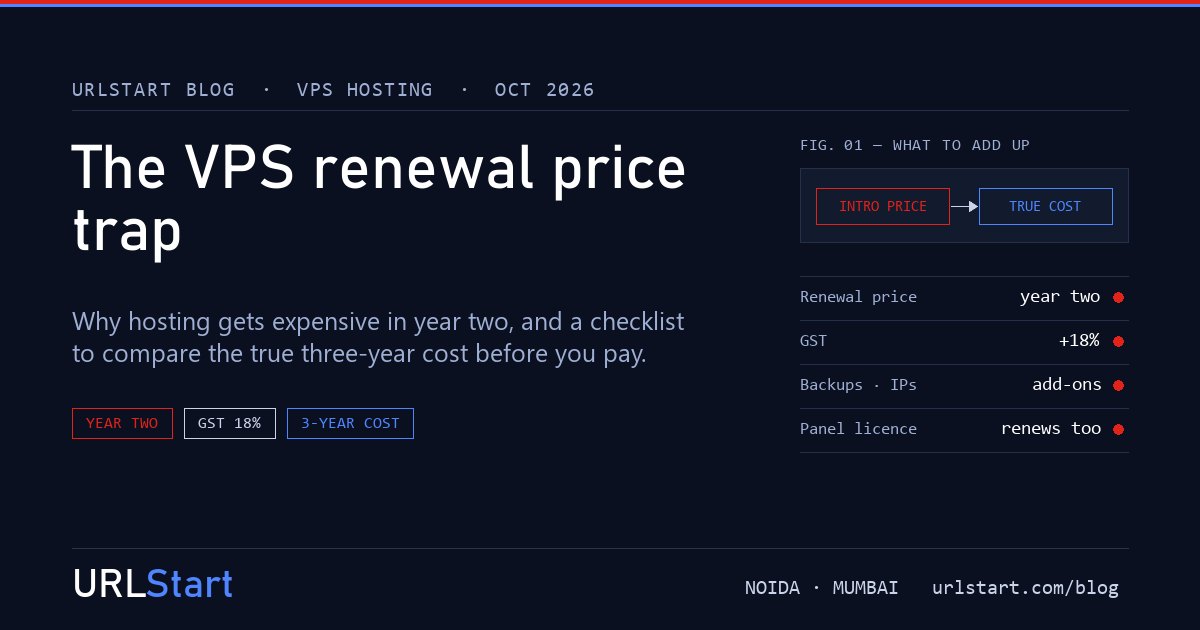
Year two tends to cost more for four reasons, often stacked together:
- The introductory discount ends.
- The discount was tied to a long term you have now used up.
- Tax was never in the headline figure.
- Things you assumed were included turn out to be paid add-ons.
What is an introductory price, and how big is the gap?
An introductory price is a first-term rate. The page might say "from ₹X a month", and in a line below it, "renews at ₹Y". The gap varies a lot by provider and by plan, so we will not quote other companies' numbers here. Check them yourself on the day you buy, because promotional prices change often.
The simple test is this: find the word "renews" or "regular price" on the plan. If you cannot find it on the product page, add the plan to the cart and look at the renewal line before you pay. If it is still not shown, ask support in writing. A provider that will not tell you the renewal price before you buy is telling you something.
Do 36-month lock-ins actually save money?
Sometimes, but read the terms first. Long terms are where the lowest monthly figures are advertised, and there are three things to check.
You pay upfront. A "per month" price on a 36-month term is usually billed as one payment for all 36 months. The monthly number is a way of describing a large single charge.
Refunds may not be pro-rated. If you outgrow the plan or need to leave after six months, find out whether you get the unused months back. Some providers only refund inside a short window after purchase.
The renewal is still at the regular price. After three years, the term ends and the plan renews at the standard rate, often without the long-term discount, unless you sign up for another long term.
A long term is a good deal when the renewal price is the same as the price you paid, and when you are confident the server size will still fit in three years. For a new project, that second part is hard to know.
Is GST included in VPS prices in India?
Usually not. Most Indian hosting prices are shown before GST, and 18% is added at checkout. That is normal and correct, but it means a ₹749 plan is a ₹883.82 charge, and the difference grows across a three-year total.
If your business is GST-registered, you can usually claim that GST back as input tax credit, provided the invoice carries your GSTIN and the provider's. We cover how that works in hosting with a GST invoice. If you are not registered, the GST is a real cost and belongs in your comparison.
Watch for providers that bill in US dollars. The price may look similar, but currency movement and card foreign transaction fees can change what you pay at each renewal, and an invoice without Indian GST details is not useful for input credit.
Which add-ons are usually charged separately?
These are the items most often left out of a headline VPS price. None of them are unreasonable to charge for. They just need to be in the comparison.
- Backups. Snapshots or off-server backups are frequently a paid add-on, sometimes priced as a percentage of the plan. On a VPS you can also run your own, but that costs time and storage somewhere else.
- Extra IPv4 addresses. One IPv4 is normally included. Additional addresses are usually a monthly charge, because IPv4 addresses are scarce and expensive for providers too.
- Control panels. cPanel and Plesk are licensed per server by their makers, and the licence is billed on top of the VPS. The licence price is set by the panel vendor and can rise at renewal, independently of your hosting price. See installing cPanel on a VPS for what the licence covers.
- Windows licences. A Windows Server VPS often carries a monthly licence fee, plus Remote Desktop licences if more than a couple of people log in.
- Management. A "managed" tier, or per-ticket charges for help beyond the basics, can change the real cost a lot.
- DDoS protection. Some providers include basic protection. Others charge for anything beyond a small threshold.
- Setup fees and bandwidth overage. Less common on VPS plans, but worth checking.
How do I compare the true three-year cost?
Use the same method for every provider, and put the numbers in one table. Here is the checklist.
- Pick the same size. Match RAM, vCPU and storage type (NVMe or SATA SSD). A cheaper plan with half the RAM is not cheaper.
- Write down the first-term price for the billing term you would actually choose.
- Write down the renewal price for that same plan and term.
- Calculate 36 months. First term at the intro price, the rest at the renewal price.
- Add GST at 18% unless you can claim it back.
- Add each add-on you need, monthly, for 36 months: backups, extra IPs, panel licence, Windows licence.
- Check the exit terms: refund window, whether long terms are refundable, and how much notice you need to cancel.
- Check what is included: DDoS protection, IPv6, bandwidth allowance, support hours.
The total at step six is the number to compare. It is often a very different ranking from the one the headline prices suggested.
What does the comparison look like in practice?
Here is the shape of the calculation for one 4 GB plan. The URLStart rows use our published Cloud VPS price for the 4 GB plan (₹749 a month, or about ₹584 a month on annual billing), which renews at the same rate. The "intro-priced plan" rows are a worked illustration of how an introductory offer adds up, not any specific provider. Swap in real numbers from the providers you are considering.
| | URLStart 4 GB, monthly | URLStart 4 GB, annual | Intro-priced plan (illustration) | |---|---|---|---| | First-term price per month | ₹749 | about ₹584 | low intro rate | | Renewal price per month | ₹749 | about ₹584 | higher regular rate | | Paid upfront | 1 month | 12 months | often 36 months | | 36 months before GST | ₹26,964 | about ₹21,032 | intro term + renewals | | 36 months with 18% GST | about ₹31,818 | about ₹24,818 | add 18% | | Add-ons to add | backups, panel, extra IPs if needed | same | check each one |
Two things show up straight away. First, a plan that renews at the same price has no year-two surprise: the three-year number is just the monthly price times 36. Second, the term you choose matters as much as the provider. Annual billing on the same plan saves about 22% here, without a three-year lock-in.
If you want to run this for other sizes, the VPS price calculator does the term and GST arithmetic for every URLStart plan. Our longer guide to what a VPS costs in India works through panels and Windows licences in more detail.
What does URLStart do about renewal pricing?
We publish one price per plan and term, and that is the price it renews at. Cloud VPS starts at ₹749 a month for 4 GB RAM, 2 vCPU and 50 GB of NVMe storage, with term discounts of 5% on 3 months, 12% on 6 months and 22% on 12 months. Dedicated servers are billed monthly, with no minimum term, and renew at the listed price. Prices are shown before GST, and every invoice is a GST invoice.
DDoS protection is included on every plan. Backups, control panel licences and Windows licences are add-ons, and we list them as add-ons rather than folding them into a headline figure. The servers run in our cage at a Tier IV datacenter in Noida, Delhi NCR (Yotta D1), where we operate the servers, storage and network and Yotta operates the building, power and cooling.
One more honest note: URLStart does not currently sell shared hosting to new customers. If you were comparing shared hosting renewals, a small Cloud VPS is the plan we would point you to, and the three-year arithmetic above applies to it.
FAQ
What is a VPS renewal price?
It is the price you pay when your first billing term ends and the plan renews. Many providers advertise a lower introductory price for the first term and a higher regular price after it. The renewal price is the one you will pay for most of the life of the server.
Where do I find the renewal price before buying?
Look on the plan for "renews at" or "regular price". If it is not on the product page, add the plan to the cart and read the renewal line before paying. If it is still missing, ask support in writing and keep the reply.
Is a 36-month plan always cheaper?
Not always. It is usually paid upfront, may not be refundable after a short window, and the renewal at the end of the term may be at a higher rate. It is worth it when the renewal price is the same and you are sure the size will still fit.
Is GST charged on VPS hosting in India?
Yes. Hosting is taxed at 18% GST, and most providers show prices before tax. A GST-registered business can usually claim it back as input tax credit if the invoice carries both GSTINs.
Why are backups not included in every VPS?
Backups need storage on separate hardware, which costs the provider money each month. Some include them, many charge as an add-on. Either is fine, as long as you add the cost to your comparison or plan your own backups.
Does a control panel licence renew at the same price?
Not necessarily. cPanel and Plesk licences are priced by the panel vendors, and they can change their prices independently of your hosting provider. Check the current licence price at renewal time.
Can I switch providers when the renewal price goes up?
Yes, but plan it. Migrating a VPS takes time, so start a few weeks before the renewal date. Check whether your current term allows cancellation without a fee, and whether the new provider offers help with the move.
Does URLStart raise prices at renewal?
No. URLStart plans renew at the price and term you bought them on. Prices shown are before 18% GST, and add-ons such as backups and panel licences are listed separately.