With colocation, you own the servers and rent everything around them: rack space, power, cooling, network and security. That makes the choice of facility more important than in any other kind of hosting. If the building has a bad day, your own hardware is the thing that goes dark, and you can't move it elsewhere in an afternoon.
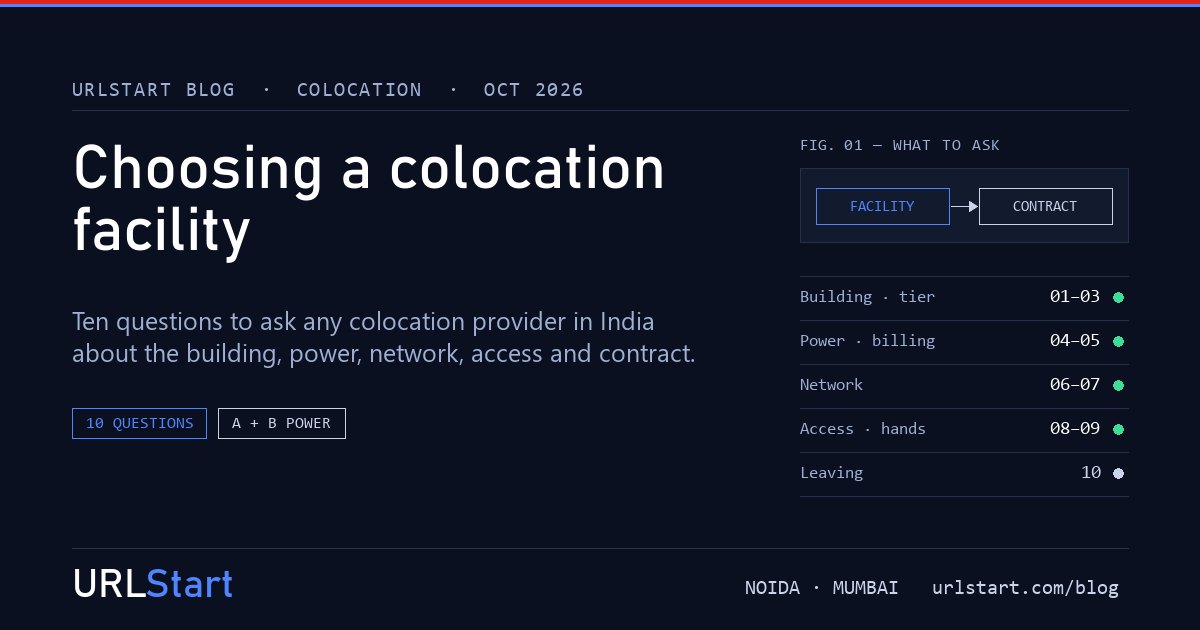
Colocation hosting offers in India tend to look alike on a price sheet. These ten questions show the differences.
The building
1. Which facility, exactly, and who runs it?
You want a name and an address, not "a datacenter in Delhi NCR". Many colocation providers are tenants inside a facility run by a specialist operator. That is normal, but they should say so plainly, and tell you which parts they run themselves and which the building operator runs.
2. What tier is it, and what does that cover?
The tier tells you whether power and cooling survive maintenance (Tier III) or an unplanned failure as well (Tier IV). For hardware you can't move quickly, that difference matters. Our explainer on what a Tier IV data center is goes through the levels. Ask whether the claim refers to the design, the construction or how the building is run.
3. How is power delivered to your rack?
Ask whether you get two power feeds, A and B, from separate paths, and how much power each rack can draw. If your servers have dual power supplies, plug one into each feed. A rack with a single feed is a single point of failure, however good the building is.
Power and cost
4. How is power billed?
This is often the biggest line on the bill. Some providers sell a fixed power allowance that you pay for whether you use it or not. Others meter the electricity you actually draw. Metered billing is usually cheaper for typical servers, which use far less than their power supply's label. Our colocation pricing guide explains the five lines on a typical Indian colocation bill.
5. What is the power limit per rack?
A dense rack can hit its power ceiling long before it runs out of space. Know the limit before you plan how many servers go in.
Network
6. What does the network include?
Ask about port speeds, how bandwidth is billed, whether you get IP addresses and how many, whether the provider has more than one upstream internet provider, and whether DDoS protection is included or extra. A single upstream provider is a single point of failure.
7. Can you bring your own network?
If you have your own IP addresses, or need a direct line to an office or another datacenter, ask about announcing your own IPs and about cross-connects, and what they cost.
People and access
8. Who can touch your servers, and how fast?
Ask how you visit: who can be on the access list, what ID they need, how much notice, and whether access is 24 hours. Then ask about remote hands, for when you can't go yourself: swapping a disk, reseating a cable, power-cycling a frozen server. Who does it, how quickly, and what does it cost?
9. What security protects the hardware?
Ask about access control at the building and the cage, CCTV, and whether your rack or cage is locked separately from other customers'.
The contract
10. How do you leave?
Ask about the minimum term, the notice period, and how you get your hardware back out. A provider confident in their service doesn't need to make leaving hard. Also check how the price changes at renewal.
Answers that should make you walk away
- They can't or won't name the facility.
- They won't say how power is billed, or the "allowance" is far above what you'll use.
- Power comes from a single feed with no option of A and B.
- There is no remote hands service, or nobody can say how quickly it responds.
- Leaving needs months of notice and fees to collect your own hardware.
Colocation with URLStart
Our colocation is in our Tier IV datacenter in Noida, Delhi NCR. The building, power, cooling and physical security are run by the facility operator, and everything in our cage is ours: the network, the DDoS edge and remote hands. We offer 1U and 2U slots, 21U half racks and 42U full racks, with metered power billing up to 10 kW per rack, a multi-ISP network, IP addresses on request and remote hands around the clock. Every rack is quoted to your hardware and power draw, and migration from your current provider is free. If you are planning a move, our colocation migration checklist covers it step by step.