Most comparisons of dedicated servers stop at the CPU and the price. The question that decides how fast your service feels is simpler: which city is the server in, and how far is that from the people using it?
In India the choice usually comes down to two places: Mumbai, the country's largest datacenter market, and Delhi NCR. Here is how to decide between a dedicated server in Mumbai and one in Noida.
Why the city matters: latency grows with distance
Every request to your server travels there and back. Light in optical fibre covers roughly 200 km per millisecond, so every 100 km of distance adds at least 1 ms to the round trip. Real routes are longer than the straight line and pass through routers, so the true figure is higher.
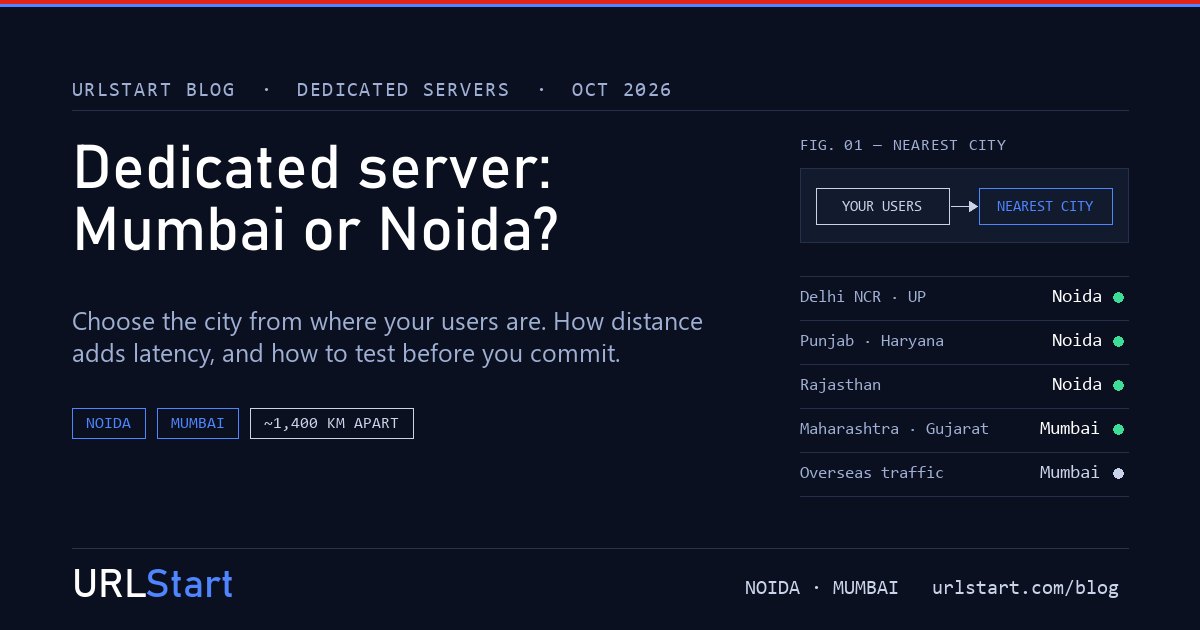
Mumbai and Noida are about 1,400 km apart by road. That puts a floor of well over 10 ms on any round trip between them, before the routing overhead that normally sits on top.
For a website, a few tens of milliseconds is barely noticeable. For a trading platform, a game server, a remote desktop or a database that an application calls hundreds of times per page, it adds up quickly. Our post on why datacenter location matters goes deeper into where it hurts.
When a dedicated server in Noida is the better choice
Choose Noida, Delhi NCR, when most of your users are in north India: Delhi, Noida, Gurugram, Ghaziabad and the rest of NCR, and Uttar Pradesh, Haryana, Punjab, Uttarakhand and Rajasthan.
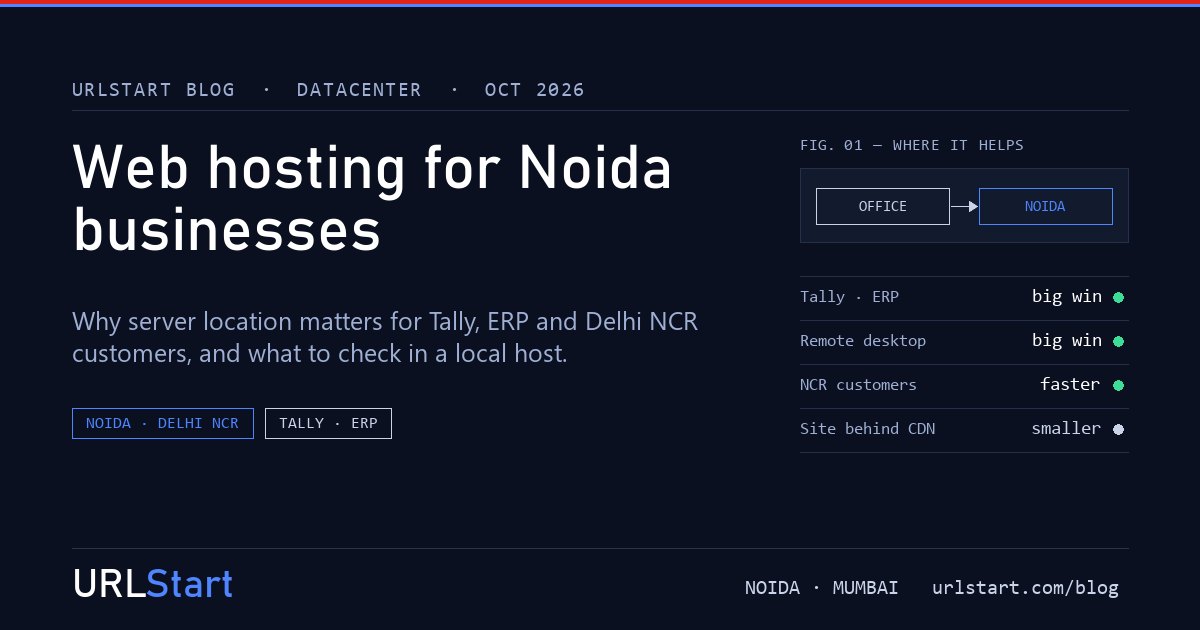
It is also the obvious choice for things your own team uses all day: Tally on Cloud, ERP, remote desktops and internal tools for an office in NCR. Those feel local only when the server is close. And if you ever need to visit, a datacenter an hour's drive away is easier than a flight.
When a dedicated server in Mumbai is the better choice
Choose Mumbai when most of your users are in Maharashtra, Gujarat, Goa and the west, or when you serve the whole country and want a central point for western and southern users.
Mumbai is also where most of India's undersea internet cables land. If a large share of your traffic comes from abroad, or your service talks constantly to systems hosted overseas, Mumbai can shorten that path.
When it doesn't matter much
For a typical website, an online shop, or an API whose users are spread across India and that sits behind a CDN, either city works. The CDN serves the static content from near each user, and the extra milliseconds on the remaining requests rarely change anything a customer notices. Choose on price, hardware and support instead.
Other things that change with the city
- The facility. Ask what classification each facility has, who operates it, and whether the same standard applies in both cities. Don't assume two locations from one provider are built to the same tier.
- Your data's location. Both are in India, which is what most data residency questions care about. Our post on data residency and the DPDP Act explains what location does and doesn't solve.
- Redundancy. Two servers in two cities protect you against a whole-site problem. If uptime matters enough, the answer to "Mumbai or Noida?" can be both.
How to test before you commit
Don't choose from a map alone. Ask your provider for a test IP in each city, then run these from where your users actually are, your office or a phone on mobile data:
ping -c 20 <test-ip>
traceroute <test-ip>
On Windows, use ping -n 20 and tracert. Compare the average round trip and look at the route: a path to Delhi NCR that detours through Mumbai or Chennai shows up in the traceroute, and it is worth knowing before you buy.
Our dedicated servers in Noida and Mumbai
Our dedicated servers are available in our Tier IV datacenter in Noida, Delhi NCR, and in Mumbai. You choose the city when you order. The builds, the price, full IPMI and the always-on DDoS protection are the same in both. Ask support for a test IP in either city and run the checks above before you decide.